
Strip Piecing Basics for Quilting

Updated: Dec 19, 2025

One of my favorite block assembly techniques for saving time is strip piecing. The satisfaction of sewing a few rows of fabric together to make multiple pieces for blocks pulls me in every time. But there are some challenges that can present themselves when using this piecing method.
The main issues can be: bowing or distortion of your straight lines and/or your pieced units not finishing at the correct size.
Luckily, there are several tips and tricks to navigate these issues. Here are a few of my favorite ways to ensure accurate strip piecing:
Prepare your fabric for cutting your strips straight
Use a Scant 1/4" seam allowance
Use a smaller stitch length
Use a presser foot with a guide edge
Use shorter length strips instead of entire width of fabric (WOF) strips
Alternate direction you sew each seam
"Set" your seams and press, not iron
Use a straight stitch plate
Preparing Your Fabric for Strip Piecing

One of the most important steps before you even begin to sew your fabric together, is to make sure your strips are cut straight "on the grain". Fabric is woven using warp and weft threads (think horizontal and vertical) and any deviation from cutting on either of these directions can result in bias stretch in your cut pieces.
Before cutting your strips, make sure your selvedge edges are matched up together. Sometimes the fabric can be a little off when coming off the bolt and if you're pre-washing your fabric, you'll need to do this anyway after pressing and starching.
(Speaking of starching, it is also helpful to starch your fabrics even if you aren't pre-washing them to help keep your pieces more structured and straight while sewing.)

Once your selvedges are lined up, hold the fabric up vertically (while holding the selvedges) to make sure the fabric is laying straight and there are no "ripples" in the fabric. If you see ripples, you'll want to shift the selvedge edges back and forth until the ripples are gone and both sides of the fabric hang flat. Below is an example of extreme "ripples" on the left to flat on the right.
Next, use the folded edge created on the opposite edge of the selvedges to line up on the bottom of your cutting mat.


Trim the fabric edge to be square with the closest line on your cutting mat. I trim the edge on the left so I can begin cutting from that edge using my right hand.

Once your left edge of your fabric is trimmed, you're ready to begin cutting your strips.

Use a Scant 1/4" Seam
Aside from ensuring your fabric is cut straight, using a scant 1/4" seam is almost as important to ensuring your strip piecing comes out accurately. The elusive scant 1/4" was a challenge for me as I wasn't entirely sure what "scant" meant.
If you're wondering the same thing, a Scant 1/4" is simply one thread width less than 1/4". Visit this blog post all about scant 1/4" to learn more.

Use a Smaller Stitch Length

The strip piecing method is an efficient way to piece long strips together, to more quickly piece quilt blocks but this requires cutting across the seams of the strips you have pieced together.
To be sure the seams on your edges of your sub-cut units remain intact until you piece them together in the block, you will want to use a smaller stitch length (generally between 1.5mm-2mm, I usually go with about 1.8mm).
Use a Presser Foot with a Guide Edge
Still working on perfecting that perfectly straight seam? Use a presser foot with a guide edge to help guide the fabric consistently through the stitch plate.
My favorite presser foot to use for mass amounts of strip piecing is my #57 Patchwork Foot with Guide on my Bernina. If I'm doing a lot of strip piecing, my eyes can get tired of focusing on the same line when sewing my scant 1/4" seam so having a guide to rest the edge of the fabric with is helpful.

If you don't have a presser foot with a guide edge, you can also buy a magnetic seam guide to attach to your machine or use washi tape/diagonal seam tape (I use Cluck Cluck Sew's tape) to establish an edge to line up your strips.

Using diagonal seam tape to mark a guide for a scant 1/4" seam
It is also helpful to keep your needle in the "down" position while sewing strips together to help allow for any adjustments needed to keep the strips straight without compromising your seam positioning.
Use Shorter Strip Lengths
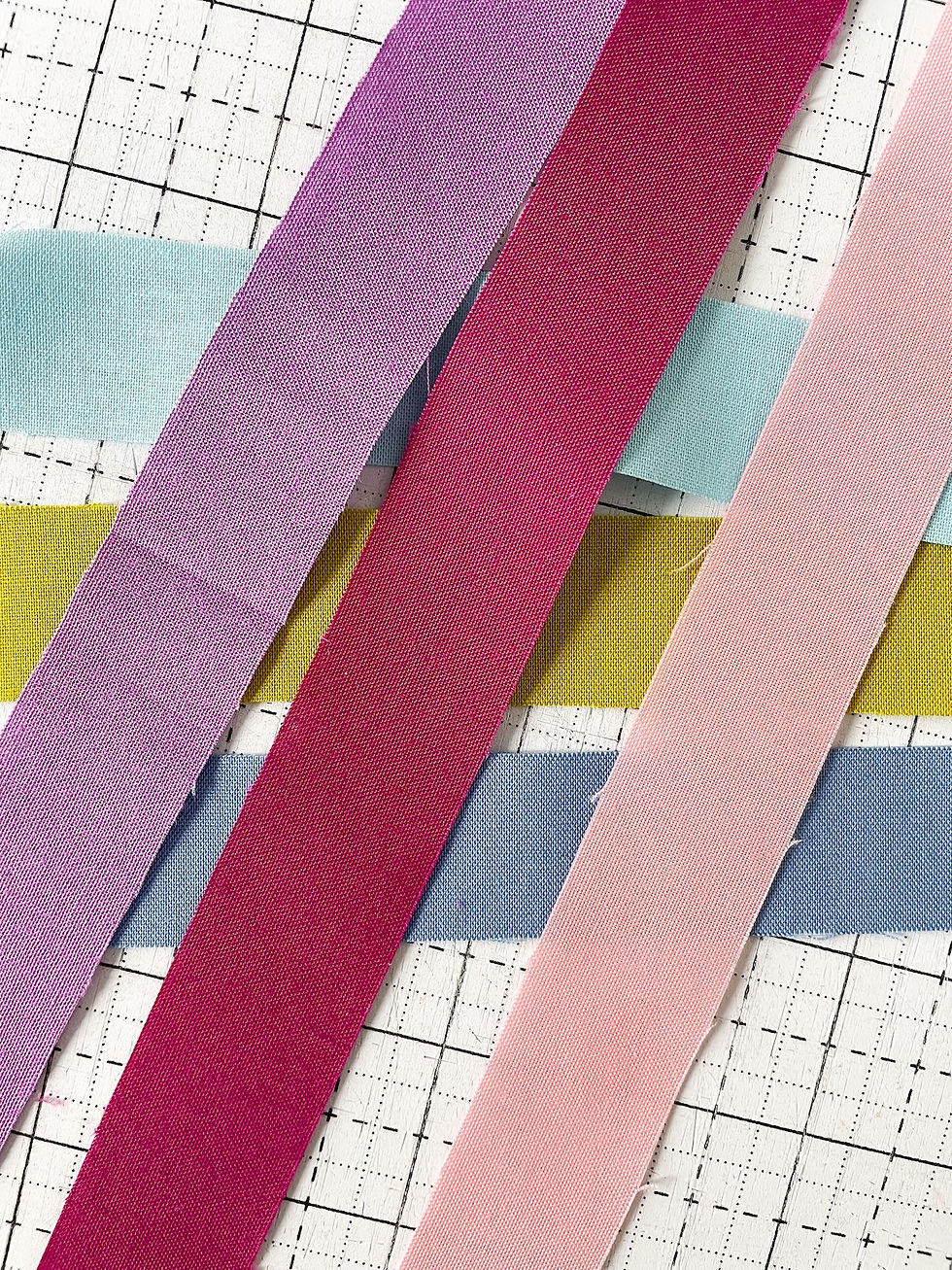
In my patterns which utilize strip piecing techniques, I like to break up the width of fabric (WOF) cuts into shorter lengths which can help to keep your pieces (especially thinner strips) from bowing or distorting when sewing them together.
If the pattern you're using does not call for it, you may consider sub-cutting the length of your WOF strips to a more manageable length (generally half or 1/3 of the WOF), especially if you are new to strip piecing.
*NOTE: be sure to read through all of the instructions in the pattern before sub-cutting your strip lengths. Some patterns require the full WOF length to be used for fabric efficiency.
Alternate your Sewing Direction
When sewing your strips together, to avoid bowing or distortion of your strips, it's a good idea to alternate the direction you sew each seam so that you're not always sewing on one side of your strips. See below for an example showing the direction each seam was sewn:

"Set" and Press (Not Iron) Your Seams

"Setting" your seams requires a simple press of the seam before it is pressed open or to the side. The heat from the setting process allows your thread to shrink slightly into your fabric, and not only does this reduce the bulk of the seam slightly but it helps to keep your seam from shifting in the pressing process.
Also important in this step, is to always "press" your seams by simply setting the iron down
on the seam while keeping it stationary. When moving down your seam, always lift the iron first, then move to the next spot to avoid pushing your seam along, potentially causing distortion or stretching.
It can help to "fingerpress" your seams prior to pressing with the iron to open them up without too much distortion.

I like to line up several sewn pieces to "set" the seam at the same time as shown above.
Use a Straight Stitch Plate
Chances are, you haven't ever thought about changing your stitch plate (I didn't until the last year or so), but changing your stitch plate to a straight stitch plate (in my case with my Bernina B350 SE, it is called a 0mm Stitch Plate) can help keep your seams precise due to the way it functions.
In essence, it has a smaller hole that the needle passes through so the fabric doesn't have as much of a chance to fall into the hole and get "eaten" by the machine. Generally, it is necessary to use this for fine fabrics but also heavy fabrics.

**A note of caution: Be careful using the straight stitch plate if you are moving your needle to achieve a scant 1/4." Instead, you may want to achieve your scant 1/4" by adding a guide for your seam if you are using a straight stitch plate.
I know, I know...that is a LOT to remember for just sewing strips of fabric together. These are the main considerations I make when I begin my strip piecing, you may find that your strip piecing is just as accurate with less or more than what is listed here.


If you've been having trouble with straight and accurate strip piecing, I suggest starting with these suggestions and see how they help.
Want to see more? Come hang with me on Instagram for video tutorials and more!


Comments